Cultivated Meat, Part 2: Are Taxpayers Helping Pay for It?

Updated: Sep 9
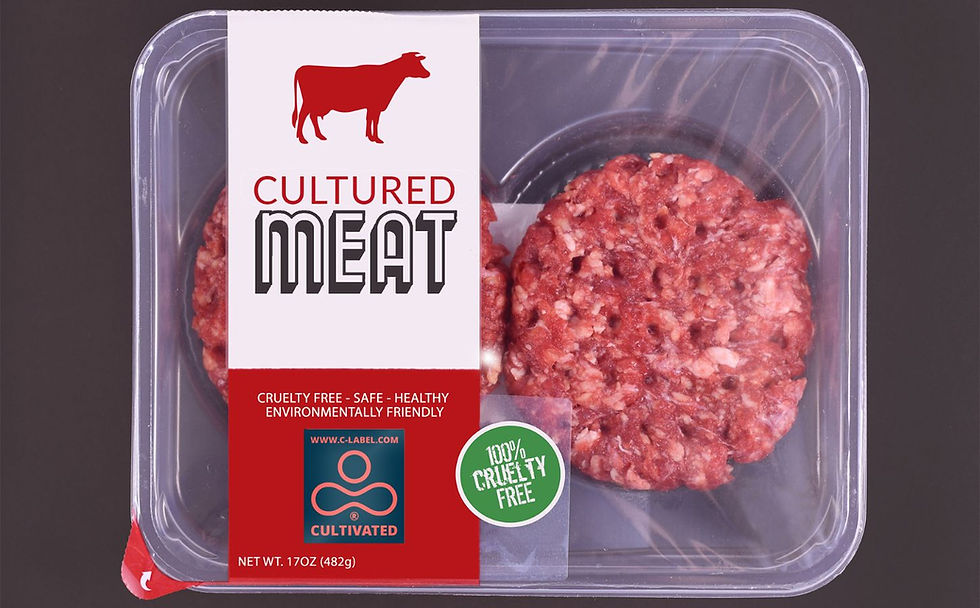
Cultivated meat is often presented as a private-sector technological gamble: investors put billions of dollars behind companies attempting to grow animal cells into food, and consumers will eventually decide whether they want to buy it.
That description is incomplete.
Public money has also helped develop the science behind cultivated meat in the United States.
The question is not whether taxpayer dollars have been involved. They have.
The more useful questions are how much public money has been spent, where it went, what taxpayers received in return, and whether public investment in this emerging food industry is justified.
The Federal Government Has Funded Cultivated-Meat Research
A Congressional Research Service report examining cell-cultivated meat found that, over roughly the preceding decade, the National Science Foundation had awarded approximately $5 million in research grants, while the USDA's National Institute of Food and Agriculture had awarded approximately $12 million for cell-cultivated meat projects.
Most of those grants went to universities rather than cultivated-meat manufacturers.
That distinction matters.
It would be inaccurate to say that the federal government simply handed $17 million to companies such as UPSIDE Foods or GOOD Meat.
Instead, taxpayers helped finance research into some of the fundamental scientific and engineering problems the industry must solve.
A $10 Million USDA Investment
The largest and most visible example came in 2021.
The USDA awarded a five-year, $10 million grant to Tufts University to establish what became the National Institute for Cellular Agriculture.
The project brought together researchers from several universities to study subjects including:
growing animal cells efficiently
lowering the cost of cell-growth media
developing biomaterials and scaffolds
scaling production
nutrition
food safety
environmental effects
economic viability
consumer acceptance
workforce development
Tufts describes the federal grant as having been instrumental in establishing the institute and coordinating research across several universities.
This was not simply research about whether cultivated meat exists.
The project explicitly sought to help develop a sustainable, cost-effective and scalable cultivated-meat production platform.
That makes this a legitimate public-policy question.
Should taxpayers help develop an industry that may eventually become highly profitable?
There are reasonable arguments on both sides.
Other Federal Research Has Contributed
Tufts also lists research support connected with the U.S. Department of Energy's ARPA-E program for work involving advanced bioreactors and the potential energy and greenhouse-gas effects of cellular agriculture.
NASA-supported work at Tufts has examined cultured insect cells as possible future food sources for long-duration space missions.
These projects have different purposes and should not all be treated as subsidies to commercial cultivated-meat companies.
But together they demonstrate something important:
The federal government has treated cellular agriculture as a technology worth investigating with public research dollars.
Public Support Isn't Limited to Universities
Government support can also occur much closer to commercial production.
Consider Believer Meats.
The cultivated-meat company chose Wilson, North Carolina, for a large U.S. manufacturing facility after announcing an investment of more than $123 million.
North Carolina offered the company a $500,000 performance-based grant from the One North Carolina Fund. The grant required the company to meet job-creation and investment targets rather than providing unrestricted cash upfront.
The North Carolina Biotechnology Center also provided a $100,000 Partnership Development Grant supporting work connected to the company and its collaboration with North Carolina State University.
Local support went further.
Official Wilson County records authorized an economic-development incentive package connected with Believer Meats that could total up to $2.5 million over five years, shared between the city and county and conditioned on investment, employment and tax requirements.
Again, context matters.
Governments routinely use economic-development incentives to attract factories, warehouses, technology companies and other employers. Cultivated meat is not unique in receiving such incentives.
But consumers deserve to know that the industry's development is not financed exclusively by venture capital.
UPSIDE Foods Also Received an Economic Incentive
When UPSIDE Foods announced plans in 2023 for a commercial-scale cultivated-meat facility in Glenview, Illinois, the state said the project qualified for an EDGE for Startups tax-credit agreement.
The proposed facility was tied to a planned $141 million investment and at least 75 jobs.
That facility announcement illustrates another category of public assistance.
A research grant and a tax incentive are not the same thing.
One finances scientific work.
The other gives a company a financial incentive to locate or expand in a particular jurisdiction.
Both involve public policy and public resources.
Why Would Government Fund This Research?
Supporters have several arguments.
Food technologies with potentially large public benefits are frequently researched before private markets can determine whether they are commercially viable.
Cultivated meat could potentially:
reduce the number of animals raised and slaughtered for food;
reduce land requirements associated with livestock;
provide additional protein sources as populations grow;
produce food under more controlled manufacturing conditions;
and, under the right production circumstances, potentially reduce some environmental effects associated with livestock agriculture.
Public research also has one advantage over purely proprietary corporate research: university researchers can publish findings that become available to scientists outside a single company.
The Tufts institute, for example, describes itself as pursuing precompetitive, noncommercial research and has developed publicly available scientific resources.
That can be a legitimate public benefit.
But There Is Another Side
Taxpayers might reasonably ask why public money should help solve technical problems for an industry backed by enormously wealthy private investors.
UPSIDE Foods alone announced a $400 million private financing round in 2022.
Meanwhile, cultivated meat remains significantly more expensive to produce than conventional meat, and commercial-scale economics have not yet been proven.
That creates an uncomfortable question:
At what point does publicly financed scientific research become public assumption of private commercial risk?
There is another issue.
Every dollar spent on one agricultural technology represents a dollar unavailable for something else.
Policymakers could instead support:
traditional farmers;
regenerative agriculture;
smaller meat processors;
food-safety enforcement;
fruit and vegetable production;
soil research;
food-insecurity programs;
or other alternative proteins.
That does not automatically make cultivated-meat research a poor investment.
It does mean its opportunity cost deserves scrutiny.
Then There Is Ownership
Perhaps the most interesting question is what happens after publicly supported research succeeds.
If taxpayer-funded scientists discover a cheaper growth medium, a better cell line or a more efficient bioreactor system, does that knowledge remain publicly accessible?
Can independent researchers use it?
Can smaller companies use it?
Can traditional farmers participate in the new industry?
Or does a handful of well-financed corporations ultimately capture most of the economic value?
Those questions matter because food is not simply another consumer technology.
Who controls food production influences prices, supply chains, rural economies and national food security.
The Maria Standard
Public investment is not inherently suspicious.
Government has financed agricultural research for generations. American farmers themselves have benefited enormously from publicly funded research involving crop genetics, livestock health, irrigation, soil science, food safety and agricultural machinery.
Cultivated meat should therefore be judged by the same standard, not subjected to a different one simply because the technology feels unfamiliar.
But public funding deserves public transparency.
Consumers should be able to know:
How much public money is being spent?
Who receives it?
What research is being performed?
Who owns the resulting discoveries?
What measurable public benefit is expected?
And will taxpayers help absorb the risk while private companies eventually collect the profits?
Those are not arguments against cultivated meat.
They are questions taxpayers are entitled to ask.
Maria Approved It™ Verdict
What we know: U.S. taxpayer money has supported cultivated-meat research, including a major $10 million USDA-funded university initiative. Federal research funding has totaled millions more across USDA and NSF programs, and individual cultivated-meat companies have also benefited from state or local economic-development incentives.
What we don't yet know: Whether cultivated meat will become economically competitive, whether its promised environmental benefits will materialize at commercial scale, and whether the long-term public return will justify those investments.
Our position: Follow the money, but follow it accurately.
Public research funding is not the same thing as a corporate bailout.
A tax incentive is not the same thing as a research grant.
And neither should be hidden from consumers.
Maria Approved It™ will keep asking where the money goes.

Comments